Q2 Tracker Link

(Cochrane Alberta Canada) Follow recent flights at: https://aprs.fi/cgmbk *******************Also YouTube channel: https://www.youtube.com/channel/UCfxJXIwvmfNlNF3gwplFw7Q

Monday, July 10, 2017

My New Electronic Ignition Installation

July 26 2017
The CPI System is timed by a Hall Sensor style of ignition timing.  I had a custom bracket fabricated for the support of the Hall Sensor and it was triangulated to mounting points on the front of the engine. This so there could not be any movement of the Hall Sensor position.


Below is a top down photo of the Hall magnetic pickup.  The magnets have yet to be installed into three of the propeller bolts.  the magnets will stick out of the face of the bolt head about 3/16 of an inch.


July 18 2017
The Coil packs sit on top of my engine and the photo below shows the aluminum mounting plate I had made up to support them.  One coil pack is for the upper plugs and the second is for the lower spark plugs.

July 10 2017
I am installing an Electronic Ignition system on my aircraft to eliminate the Bendix D3000 dual magneto that is presently installed on the back of the engine.  The Electronic Ignition system is a made in Canada solution from a reputable supplier of ignitions for race car and aviation purposes.  The company is Racetech Inc. and the product they have for my application is the CPI (Coil Pack Ignition) System.  This is the system designed by "Racetech Inc." for engines which are normally aspirated.  They also have another product designed for the Fuel Injected engine.  Their web page can be viewed at  http://www.sdsefi.com/

There are two main reasons that I wish to change my ignition.  First I have been getting a lot of static over my radio that has been proved to be from both sides of the magneto.  Second the magneto is located on the back side of the engine case and if it has to be serviced the engine has to be removed to access the magneto.  This is not a ideal design but being the plane was designed for it's compactness, light weight and aerodynamic shape that was a necessary evil of this fabulous flying airplane.  As a result the magneto and starter sit inside of a recess well behind the main firewall.  I have had to remove the engine a couple of times to work on the magneto already and have been looking for a solution.  Removing the engine was a time consuming and arduous task needing some acrobatic agility.  Finally the cost of overhauling the magneto was more than the cost of a electronic ignition. The CPI offers the simplicity and reliability as used in most all automobiles these days.
Below is the result of the engine cowling that I had to enlarge the main propeller opening.

My project is not the first to go through this type of change but does require some specialized custom brackets to be made for my Revmaster aviation engine.  Racetech Inc. has made up brackets for more common aircraft engines but my engine is rare and so the customized brackets.


Saturday, June 24, 2017

Flight to Vulcan Alberta for Lunch

It was a beautiful day with some high scattered cloud around, a mostly sunny day.  Temperature was at 24 degrees C in the afternoon.  We flight planned for an altitude of 5500 ft for this short flight to the SE from Springbank airport.  The flight time was showing to be a 41 minute flight using my FltplanGo software with the current winds.  The actual flight time turned out to be 42 minutes and we encountered very light turbulence due to the daytime heating beginning.

I was accompanied by Alan in his RV3 who flew about 5 minutes behind me as we departed Springbank.  The RV3 is faster than the Q2 and I knew this would work out fine for our 41 minute trip to Vulcan.  The landing strip is paved and 2950 feet long at a elevation of 3440 feet.  My landing went very well and I used about 3/4 of the runway length before turning around and backtracking on the runway.  After climbing out of my cockpit on the parking ramp I heard Alan arriving on the downwind approach for landing and was able to watch his nice 2 wheel landing.  As we stood talking after Alan shut down we heard a sound similar to a turbine coming into the airport.  Not a turbine at all but the exquisite Subaru powered Q2 of Reg Clarke from the Lethbridge area.  Reg later noted he was probably going about 150 knots as he flew over top the airfield, what a beautiful sound.  He quickly slowed and did a beautiful landing.  Reg later explained to me that he has to have a very light touchdown as there is no landing gear shock absorption in his custom landing gear configuration.  This is very different to my Q2 in which the full Canard wing is a spring for my landing gear.
We were going to walk across the golf course to lunch in the club house but a local pilot Don was admiring our planes and offered to drive us over.  We had a nice lunch with great conversation around the table.  We walked back to the airport (15 minute) from the golf course and prepared for departure.

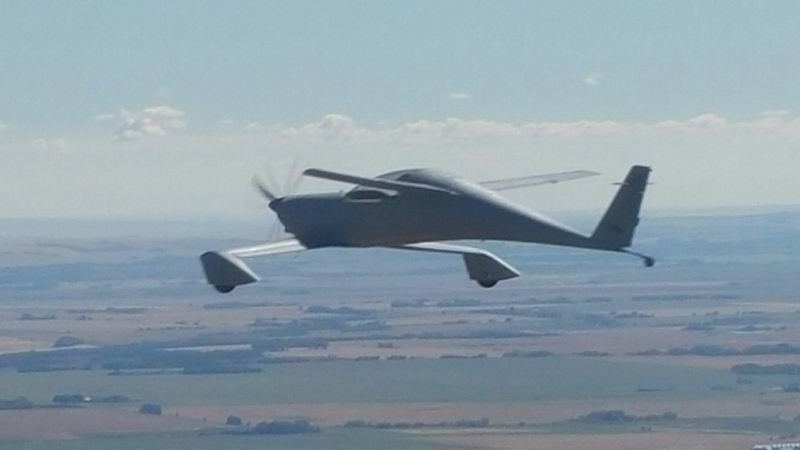
  Alan left right away for a meeting back home and Reg offered to do a tandem takeoff with me on our departure.  He would give me a comfortable lead and shortly after takeoff he called me up his position and I saw the beautiful yellow Q2 screaming by about 300 feet below in our left turn. This turbo Subaru with an SDS electronic ignition system from Ross Farnam in Alberta is one fine example of a Q2 tandem wing aircraft.

View or trip track at:
https://aprs.fi/#!mt=roadmap&z=11&ts=1498262400&te=1498348800&call=a%2FCGMBK
More coming soon.

Saturday, June 17, 2017

Fun flight for lunch

We organised a fun flight to Red Deer Alberta for a lunch once again.  I was joined by my friend Joel in his "Cozy Mk 4" and had a visit from another friend up from Lethbridge in his Q2 with a Turbo Subaru engine.  Reg's airplane is a beauty but we missed each other on this trip by a mere 15 minutes.  We will get together later and I will supply some pictures of his plane.

A great chance to burn off a bit of 100LL fuel and see how my plane is performing.  I was very pleased with the how my Q2 is operating.  There are only two small repair items that have to be attended to and they has now been completed.  One was tightening up a mounting point for my trim system and the other a test of  my tracking system to find out why my APRS transmission is interfering with my engine monitor display.  We had  a great flight with 25 km wind from the NW and only scattered cloud up around 8000 feet.    This flight was at 6500 feet each way and the flight time was 45 minutes each way.  Joel mentioned he could not spot my plane as he was gaining on me from behind.  Considering I have a strobe on top and on the belly of the plane that is a surprise to me although I know my surface area is extremely small.  I just love flying this airplane with it's sensitive fingertip control and fabulous view out of the large bubble canopy.

Click this link to see map of trip:
https://aprs.fi/#!mt=roadmap&z=11&ts=1497657600&te=1497744000&call=a%2FCGMBK
More coming soon.

Saturday, October 22, 2016

Fourth Cross Country Test Flight (Canada)

Saturday October 22/16 we organized a trip to Medicine Hat Alberta (elev 2350 rwy 5000 ft) for lunch.  This would be my fourth and longest cross country trip  so far and would give me an opportunity to test out the Q2 for a longer engine run time.  For this flight I also would be carrying more fuel and this would allow me to test at higher weight and enable another fuel consumption calculation.  Empty weight is 628 lbs with all my regular travelling items on board..  My airplane gross weight is listed at 1100 lbs but that I believe is not practical for our 4000 ft elevation so I am using 1000 lbs as my realistic gross weight, (aircraft was originally from a sea level airport).   This flight had my full weight at 913 lbs and the fuel on board would allow 4.0 hours flight time and still have 30 min reserve remaining.  Later flights will test the actual weight carrying ability by gradual increases of sandbag weight.   I departed Springbank CYBW (3960 ft) and after a standard departure procedure I was able to have a requested flight altitude of 7500 ft.  Two other aircraft flew nearby in radio contact to watch over me and this once again made me feel very relaxed.  Air flight time on this trip ended up being 1.4 hr to Medicine Hat and 1.7 hr returning.  I was very happy with the performance of the engine since top overhaul and again I was happy to see temps and pressures staying in the normal range.  A new bug to fix since this flight is my wind sealing around canopy edges.  Outside temp I am guessing was +1C at 7500 ft and I got cold air coming in, the new cabin heat I  installed worked very well but the outside air leaks will have to be weather stripped.  Of course I knew this would probably be required but I like to torture myself a bit first.  Flight home was at 6500 ft and enjoyable at a slower ground speed as I plodded directly into the headwind.  Cockpit was warmer in the afternoon and occasional direct sun really warmed up the cozy little space.  This flight fuel consumption I calculated at 4.1 gal per hour including all start up and taxi use.  I am not leaning aggressively as I want a little fuel cooling of the cylinders during ring seating. 

We had a fabulous turnout for lunch with fourteen great people and eight airplanes.

C-195 Brian, Cherokee 235 Bob, Citabria Logan, Cavalier Stu, Bushcaddy Glen, RV3 Alan, Cozy MK4 Joel.


Thursday, September 29, 2016

Third Cross Country Test flight

September 29/16 I made another cross country test flight in C-GMBK and once again it was to Red Deer Alberta.  On this flight my primary test was to check out the MGL V6 radio since getting new settings advice from MGL and from a forum group.  The new settings worked perfect and have eliminated my excessive background static type noise. Both groups informed me I needed to set my mic. Gain to -10.5db and one other setting change.   MGL and the forum also informed I needed to set my radio to VOX and not VOG if using a ANR type headset.  The VOG is a proprietary setting offering many adjustments for “Voice Automatic Gain Control”  and is used primarily to give passive headsets the ability to have quieter sound as found in ANR headsets.  The changes recommended have totally cleared all background noise I was encountering.  The sound was actually engine and cockpit noise amplified in the “Sidetone” circuit creating high ambient noise.  I still have a snapping noise that has been isolated to the magnetos and is likely the capacitors in the magneto, cost $300.00 for two.  My plan is to put that money toward installing a electronic ignition.

Now to  the flight, it was outbound at 6500 ft and I found my groundspeed up at 145mph.  This was due to a 15mph tailwind which was giving me a push.  The engine ran like a charm and I was very pleased to see all engine parameters staying once again within normal ranges.  Not like the last flight which was a clear day, this day had a solid cloud layer at about 7000ft.  I really enjoy the cloud cover as I don’t get the greenhouse effect in the cockpit which can make it a bit to warm at times.  Air ventilation is working fine and because this test flight was at 11 degrees “C”,  I had to close off the eyeball vents.  I can feel some cool air coming in through the open spaces around my canopy frame and these will be closed with weather stripping soon.   This airplane is so much fun to fly, it fly’s hands off and needs only light finger tip control on the center stick.  This is so much fun and a great reward for the three years rebuilding CGMBK.  The bonus is, I now have the pleasure of cleaning bugs of my own airplane.
Track my plane at:  http://aprs.fi/cgmbk
Web page:  http://calvinthorne.blogspot.ca

Wednesday, September 14, 2016

Second Cross Country Trip

On September 14/16 I flew my Q2 C-GMBK for its second cross country trip.  This time each leg was a bit longer than the last trip which had three legs.  This time we headed from Springbank (CYBW)  to Red Deer Alberta (CYQR), the flight to get there was 42 minutes flying time.  The airport elevation is 2970 ft and we used the 3400 ft runway.  Alan in his RV6a was kind enough to accompany me on this flight as my safety aircraft.  We went for a lunch at the "Hangar Pub" which is only 2 blocks from the airport tower and then did the return trip home.  Flight outbound was at 6500 ft. and my airspeed seems to be at a pretty constant 125-135 mph.  Power was at full most of the time showing 3000-3050 rpm but I reduced to 2800 rpm at times.  Temperatures and pressures were steady and in the normal ranges.  Visibility out of my new canopy provided a spectacular viewing platform and I had more time to look out and enjoy it this time. The aircraft is flying hands off with only fingertip control required on the centre stick.  There is no tendency to roll and the roll trim mechanism into the stick works great.  Pitch trim is controlled from the T-tail trim and this is working fantastic, I can control climb, decent and minor cruise pitch changes with small amounts of twist into the vernier control (my design).  Landings are good and I am now trying to make them shorter.  I am still enduring background static on my MGL V6 radio but have just received some good advice on changing settings from a Forum and from MGL.  I will relay any improvements in a later posting.
 Flight tracker at:  http://aprs.fi/cgmbk

Below are aircraft from Airspray Firefighting and Buffalo Airways Maintenance facility at Red Deer airport Alberta.


Saturday, September 3, 2016

First Cross Country Trip

September 3/16
It's official I finally got away for my first cross country trip.  A friend in his Cozy Mk 4  and another friend in his RV3 joined me as safety aircraft for the trip.  This flight was just a short one departing our home airport of Springbank CYBW and going to Olds/Didsbury then Three Hills then returning home to Springbank.  We all made a stop at each airport so I could check my engine compartment for any oil leaks.  At Three Hills we were lucky to have arrived for their monthly coffee and muffins and stayed for a couple of hours.  We chatted about lots of airplane stuff and received a tour from Dennis Fox of his brand new RV8 that just came back with a beautiful paint job.  Thanks to everyone!

The plane ran like a charm and there were no oil leaks at all.  First leg I kept power off a bit an saw 125 mph.  Later on I let it have full power and saw 135 mph and a rpm of 2950-3000.  All temperatures and pressures were normal.  My two friends had to really pull back on their power because they are much faster than the Quickie Q2 with its small Revmaster engine.

Total distance on the trip was 130 miles and I logged 2.1 hours in the air.  What a great day this was for me finally.  The time spent on this project has been all worthwhile.  This is the second 100% rebuild of this Canadian aircraft.